
Material Handling Equipment Supplier for Warehouses and Bulk Yards
Strongmac supplies forklifts, electric stackers, pallet trucks, AGV robots, conveyors and stacker-reclaimers from Shanghai. We help you match each machine to your loads, floor and layout, then inspect it and ship it with full export documents.
Strongmac is a material handling equipment supplier for two very different environments: warehouses and factories that move palletized goods, and plants, ports and stockyards that move bulk material by the thousands of tonnes. From our Shanghai head office we source and export the full material handling equipment range, including diesel, LNG and electric forklifts, walkie and ride-on stackers, reach trucks, pallet trucks, automated guided vehicles, belt and en-masse conveyors and stacker-reclaimers.
Our buyers include logistics operators, distributors, manufacturers, cement and power plants, mines and port operators. Some need a few forklifts for a new warehouse; others are building a complete bulk storage yard and need conveyors and reclaimers sized to the plant around them. A third group is automating: replacing repetitive manual transport with AGVs while keeping forklifts for flexible work. Each case starts with the same question: what moves, how far, how often and in what space?
In both cases we follow the same four steps:
- Specify – our in-house engineers review load weights, lift heights, aisle widths, duty cycles, material properties and site layout with you.
- Source – we identify suitable machines from producers in China and confirm configuration, battery or engine options and accessories.
- Check – each unit goes through pre-shipment quality inspection; you can attend, join by video or appoint a third-party agency.
- Ship – we pack, document and book freight so the equipment arrives ready to unload.
Material handling rarely stands alone. Bulk stacker-reclaimers and conveyors often form part of a cement line, so many buyers combine them with crushers and mills from our cement plant equipment range. Textile and garment factories add forklifts and stackers to the machines they buy from our textile machinery range, which lets inspection and shipping run as one consolidated order with a single set of export documents.
The sections below explain each equipment group and what to compare before you buy. When you have your requirements, request a quotation and we will reply with price, lead time and shipping.
Diesel, LNG and electric forklifts from a forklift supplier in China
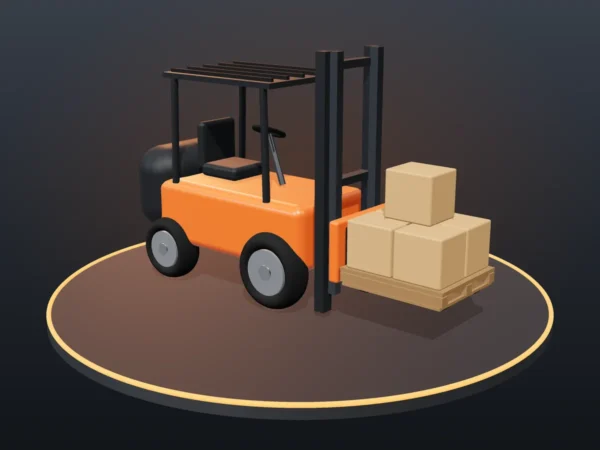
Forklifts are the most common machine in any warehouse, yard or factory. As a forklift supplier in China, we offer diesel, LNG and electric counterbalance trucks so you can choose the power source that suits your site, fuel costs and emission rules.
A diesel forklift is the default for outdoor yards, timber and steel stockyards, and heavy loads on rough ground. An LNG forklift runs on liquefied natural gas, which can cut fuel cost and exhaust emissions where a gas supply is available. An electric forklift produces no exhaust at the point of use, runs quietly and is the preferred choice indoors, in food and pharmaceutical storage, and wherever charging power is reliable. The warehouse forklift is set up for indoor pallet work on smooth floors.
Compare rated capacity at the load center you use, maximum lift height and residual capacity at that height, mast type (duplex, triplex, free lift), tyre type for your floor, turning radius and battery type and capacity on electric models. Also check attachments such as side shifters, fork positioners and clamps, and the availability of filters, tyres and batteries locally.
Electric stacker, reach truck and pallet truck options
For indoor warehouses, electric stackers and pallet trucks often handle more pallets per day than counterbalance forklifts. They are compact, quiet and cheap to run, and they work in narrower aisles, which increases storage density.
An electric pallet truck moves pallets horizontally across docks, staging areas and production lines. A walkie type electric stacker adds lifting, so the operator can place pallets on low and medium racking while walking behind the machine. For longer travel distances and higher throughput, a ride-on electric stacker lets the operator stand or sit on board. Where racking is high and aisles narrow, an electric deep reach truck extends its mast forward to reach pallets stored two deep.
When choosing an electric stacker, compare rated capacity, lift height, the aisle width the machine needs for a right-angle stack, battery voltage and capacity, charging type and time, and whether the chassis straddles or spans the pallet. Floor flatness matters more as lift heights rise, so share your floor specification and rack drawings with us. Training operators on battery care also extends battery life considerably.
Automated guided vehicles from an AGV robot supplier
Automated guided vehicles move loads without a driver, following a programmed route using navigation methods such as magnetic tape, QR codes, reflectors or laser mapping. As an AGV robot supplier, we offer several types for factories and warehouses that want to automate repetitive transport.
A roller type AGV carries a powered roller deck that transfers totes, boxes or pallets directly to and from conveyors and workstations. A compact carrier AGV slides under racks or carts and lifts them, which is common in goods-to-person picking and assembly lines. A forklift type AGV picks pallets from the floor or low racking and places them without an operator, bridging manual forklift work and full automation. Mixed fleets of AGV types are common once the first routes prove reliable.
Before buying, map the routes, load types and transfer points. Compare payload, navigation method, positioning accuracy, travel speed, safety sensors and stopping distance, battery life and charging (manual or automatic), and how the fleet integrates with your warehouse or manufacturing system. A pilot with one or two vehicles is a practical way to confirm performance before scaling up.
Bulk conveyors from belt conveyor manufacturer partners
Conveyors are the most efficient way to move bulk material continuously between crushers, stockpiles, silos, mills and loading points. We source conveyors from belt conveyor manufacturer partners in China and handle specification support, inspection and export.
A bulk material belt conveyor carries ore, coal, limestone, clinker, grain and aggregate over short or long distances, on the level or on an incline. Key points to compare are capacity in tonnes per hour, belt width and speed, conveying length and lift, belt type and strength, idler spacing and drive power. Material properties such as lump size, abrasiveness, temperature and bulk density affect belt and idler selection, and covers or galleries may be needed for dust and weather protection.
An en-masse conveyor moves fine or granular material in a closed casing using a chain with flights. It is dust-tight and can handle hot material, so it is often used for cement, fly ash, raw meal and coal powder. Compare casing width, chain type and speed, material temperature and the number of inlets and outlets.
Send a layout sketch with distances, elevations and transfer points so our engineers can check the arrangement.
Stacker reclaimer systems for bulk storage yards
Stacker-reclaimers build and recover bulk stockpiles in cement plants, power stations, steel works, mines and ports. They also blend material as it is stacked and reclaimed, which evens out variations in quality before the process.
A circular stacker reclaimer works in a round storage yard, often under a dome, and offers good blending in a compact footprint. For longitudinal stockpiles, a portal scraper reclaimer spans the pile, while a side type scraper reclaimer works from one side and suits narrower yards. A bridge type scraper reclaimer reclaims across the full pile face and gives a high blending effect, which is valued for limestone pre-homogenization.
The range also includes a side boom stacker, an over pile stacker reclaimer and a combined stacker and reclaimer for yards where one machine must do both jobs.
Compare stacking and reclaiming capacity, pile dimensions and storage volume, the blending ratio required, material flowability, rail span and yard layout, and the control and automation level. Stacker reclaimer projects are tied to civil works, so share yard drawings, geotechnical data and the planned feed and discharge conveyors early. That lets our engineers confirm machine type and rail layout before civil design is fixed.
How to choose material handling equipment
Know your loads
List the heaviest, widest and most frequent loads, including pallet sizes and load center. For bulk systems, define material type, lump size, bulk density, moisture and temperature. These numbers set capacity, mast, belt and structure choices, and they help our engineers avoid both undersized machines and unnecessary cost. If loads vary widely, size for the heaviest regular load, not a rare exception.
Measure the site
Aisle widths, rack heights, door openings, floor flatness and ramp gradients limit which trucks can work in a warehouse. In bulk yards, pile footprint, rail span and conveyor routes matter. Send drawings or photos so we can confirm that the proposed equipment fits and can turn, lift and travel safely. A short video walk-through of the site is often just as useful.
Choose the right power
Electric trucks suit indoor work and low noise; diesel suits heavy outdoor duty; LNG can lower fuel costs where gas is available. For electric fleets, plan charging points, power supply and battery type. Running cost over several years often matters more than purchase price when comparing power options, so include energy prices in your comparison.
Match duty cycle
A machine running one shift a day has different needs from one running three shifts without a break. Share hours of operation, moves per hour and travel distances. This decides battery capacity, cooling, drive components and whether you need spare batteries or extra vehicles to cover peak demand during busy seasons.
Plan automation step by step
AGVs and automated reclaimers deliver the most value when routes and processes are stable. Start with clearly defined, repetitive transport tasks, check how vehicles will connect with your software and safety systems, and consider a pilot before a full rollout. Our engineers can help outline the first phase and the data needed to plan it.
Check service and spares
Tyres, forks, chains, batteries, filters, belts, idlers and scraper parts all wear. Ask which consumables each machine uses, how standard they are and whether manuals and parts books are available. Ordering a spares kit with the equipment reduces downtime, especially at sites far from major supply centers or ports.
Where material handling equipment is used
Warehouses and distribution centers
Electric forklifts, reach trucks, stackers, pallet trucks and AGVs receive, store, pick and dispatch goods. Matching truck type to aisle width and rack height has a direct effect on storage density, pick rates and overall warehouse throughput.
Manufacturing plants
Forklifts and AGVs feed raw materials to production lines and move finished goods to storage. Roller AGVs connect conveyors and workstations, cutting manual transport in assembly, electronics, packaging and textile factories.
Cement, power and steel plants
Belt and en-masse conveyors and stacker-reclaimers move and blend limestone, coal, clinker, ore and additives between storage and process, often running around the clock, so availability, dust control and easy access for maintenance are key selection points.
Ports and bulk terminals
Belt conveyors, side boom stackers and scraper reclaimers handle coal, ore, grain and fertilizer between ships, stockpiles and rail or truck loading, while diesel forklifts and stackers work on general cargo and containerized goods in the terminal yard.
Mines and quarries
Conveyors carry crushed ore and aggregate from the pit to stockpiles and plants, reducing truck haulage. Stacker-reclaimers build product piles by grade and load out material for dispatch by rail, truck or ship.
Cold storage and food logistics
Electric forklifts, stackers and pallet trucks are preferred in food, beverage and cold storage warehouses because they produce no exhaust. Low-temperature versions need suitable batteries, oils and seals, so mention freezer work in your request.
Browse the product categories

Material Handling Equipment questions
Do you manufacture forklifts and conveyors?
No. Strongmac is a supplier and exporter based in Shanghai. We source material handling equipment from producers in China, help you specify it with our in-house engineers, inspect it before shipment and arrange export documents and freight. You get one point of contact for warehouse and bulk handling equipment.
Electric or diesel forklift: which should I choose?
Choose electric for indoor work, clean environments and low noise, as long as you can provide charging power. Choose diesel for heavy outdoor duty, rough ground, long shifts and sites without reliable electricity. LNG forklifts are an option where natural gas is available and you want lower fuel cost than diesel.
What is the difference between a stacker and a reach truck?
A stacker lifts pallets with forks between its support legs and suits low to medium racking. A reach truck extends its mast or forks forward, so it can place pallets in higher racking and narrower aisles. A deep reach truck can also store pallets two deep.
Can AGVs work alongside manual forklifts?
Yes, many sites run mixed fleets. AGVs use safety sensors to slow and stop around people and vehicles, but routes, crossing points and traffic rules must be planned carefully. Our engineers can help review your layout and suggest where AGVs fit best in the first phase.
What do you need to quote a belt conveyor?
Provide the material, capacity in tonnes per hour, conveying length, lift, lump size, bulk density, temperature and a layout sketch showing feed and discharge points. Mention any covers, galleries or dust controls required. With this data our engineers can size belt width, speed and drive.
Which stacker reclaimer suits limestone blending?
Bridge type scraper reclaimers and circular stacker reclaimers are both widely used for limestone pre-homogenization because they reclaim across the full pile face. The choice depends on yard shape, storage volume, required blending ratio and whether the yard will be covered. Share your yard drawing for a recommendation.
Can I inspect equipment before shipment?
Yes. Every order goes through pre-shipment inspection. You can attend, follow by live video or appoint a third-party agency. For forklifts and stackers this usually includes functional lift, tilt, travel and braking tests, plus checks of serial numbers, battery and charger, and accessories against the order. See our quality inspection page for how the process works.
Do you ship material handling equipment worldwide?
Yes. Warehouse and port equipment is delivered to buyers in Asia, Africa, Europe, the USA, Canada and Australia. Forklifts and stackers usually travel in containers or on flat racks, while conveyor and stacker-reclaimer structures are packed as steel sections and assemblies. We prepare export documents and advise on the most practical shipping method.
Often bought together
Let’s spec
your next
project.
Send your requirement — our engineers reply with the right equipment, pricing and lead time.